
Beyond Decorative Visuals: Visuals as Part of the Learning Process

Updated: May 28

Visuals Are Often Misunderstood
A strong curriculum does more than present information. It structures how students process, organize, and understand that information. One of the most overlooked tools in accomplishing this is the proper use of visuals.
In many educational settings, visuals are treated as secondary. They are often added for decoration, engagement, or entertainment after the “real learning” has already been designed. A page may contain colorful illustrations or attractive graphics, but the visuals themselves are not actually part of the learning process.
At the same time, other classrooms avoid visuals almost entirely, viewing them as unnecessary simplifications that distract from serious textual learning.
Both approaches miss the deeper role visuals can play in education.
Making Thinking Visible
Visuals are not merely additions to learning. When properly designed, they become part of how students think, process, and organize information. They help make relationships visible, reduce cognitive overload, clarify structure, and connect abstract ideas to concrete understanding. Particularly for younger students, visuals often serve as the bridge between seeing words and actually understanding what those words mean.
This is especially important in Torah learning.
A child can technically translate words without truly understanding the flow of the Posuk, the relationships between the characters, or the structure of what is taking place. Information may remain fragmented rather than becoming an organized understanding connected directly to the text itself.
Visual structure helps bridge that gap.
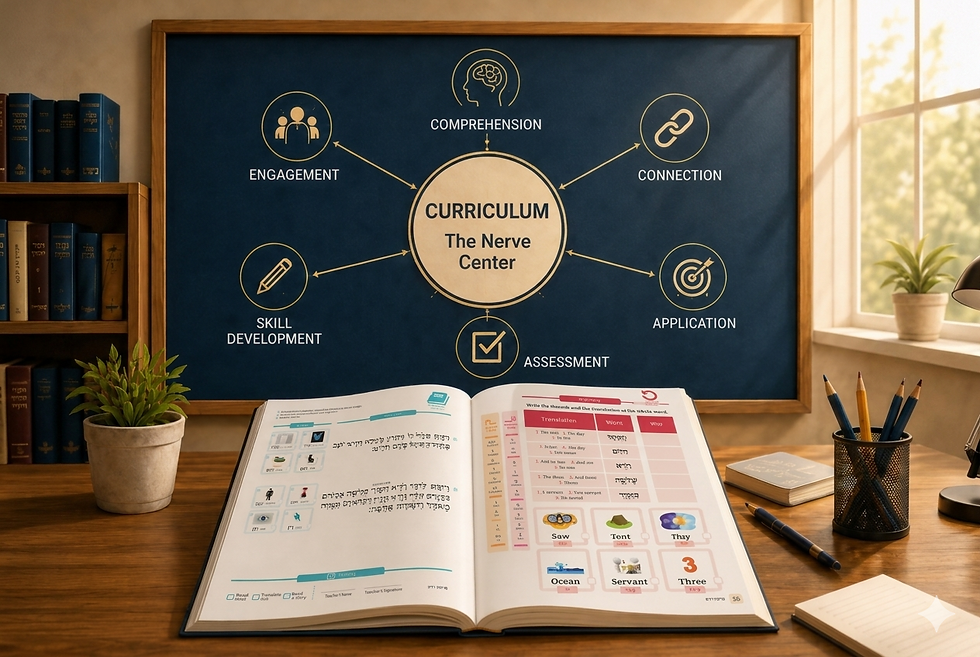
In an Applied Torah Learning System, visuals are not separate from the curriculum. They are integrated directly into the learning process itself. The visual elements are designed to support comprehension, organization, and independent thinking within the live text.
For example, a visual may help students:
identify who is speaking to whom
connect pronouns to the correct subject
organize the sequence of events
recognize relationships between Pesukim of flow of a sugya /discussion in Gemara
visualize the structure of a narrative
connect abstract language to concrete meaning
understand cause and effect within the text
Importantly, the visual is not replacing the text. The visual is guiding the student back into the text with greater clarity and understanding.
Training Students to Notice Details
Visuals also train students to observe details that might otherwise be overlooked.
When students are asked to visualize how a scene actually appeared, they naturally begin paying closer attention to the text itself. Details that might otherwise be skipped suddenly become necessary for understanding what is taking place.
A student trying to visualize a Posuk may begin asking:
Who is standing where?
Who is speaking?
What exactly happened first?
What did the scene actually look like?
Which details in the Posuk change the understanding of the event?
In this way, visuals do not pull students away from the text. Properly designed visuals often push students deeper into the text.
This process trains students to read more attentively and think more concretely about the Torah being learned. Instead of viewing the words as abstract translation exercises, students begin processing the Pesukim as real events, real conversations, and real situations that must be understood accurately.
Visuals in an Applied Torah Learning System
A visual that merely entertains may hold attention temporarily, but it does not necessarily build learning independence. In contrast, a visual that organizes thinking helps students process information themselves and gradually develop the ability to learn more independently.
This principle appears throughout the Torah For Children system.
In the Children’s Chumash, visual organization tools help students connect comprehension directly to the Pesukim. Picture-linking activities train students to associate textual details with meaning and context. Sequencing tools help students follow the flow of events. Open-ended matching activities in higher levels require students to actively analyze and connect information rather than simply identify obvious answers.
The goal is not simply that students “enjoy” learning. The goal is that students learn how to process Torah in an organized and meaningful way.
The same principle extends beyond Chumash.
In Kriah, visual structure helps students recognize patterns and relationships within the reading system rather than merely memorizing isolated sounds. In Gemara, visual organization tools help students understand sequence, flow, and the structure of discussion so that the text becomes processable rather than overwhelming.
From Support Tool to Learning Structure
When properly integrated, visuals become part of the cognitive architecture of learning itself.
This is why visuals should not be viewed as optional extras added after the curriculum is built. They are often part of the structure that enables understanding to develop in the first place.
A student who can independently organize, process, and connect information is no longer merely repeating information. The student is beginning to learn independently.


Comments