
Curriculum: The Nerve Center of the Classroom

Updated: May 26
The True Driver of Classroom Outcomes
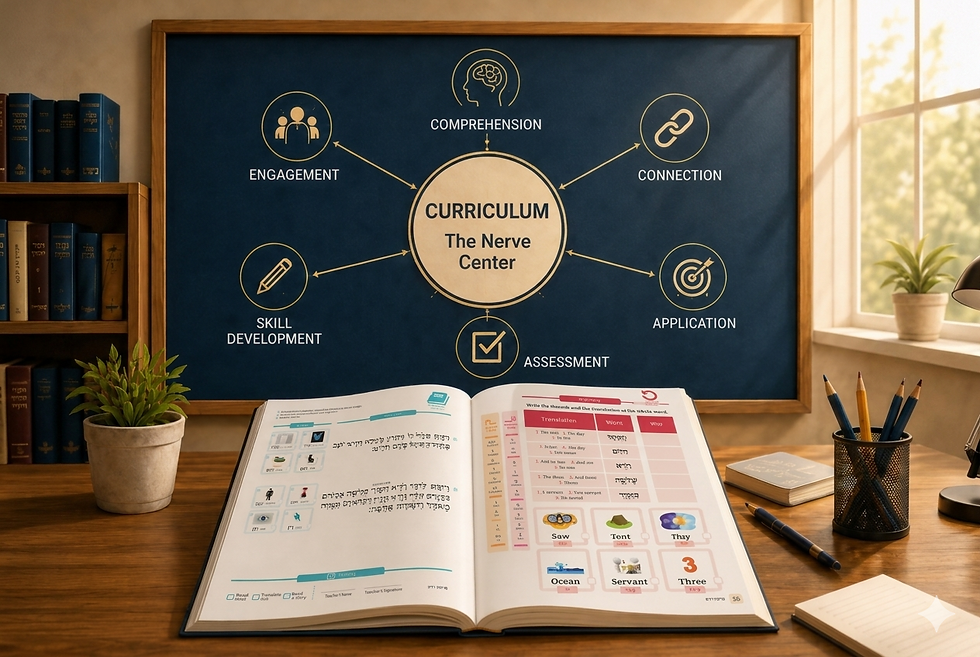
In many classrooms, the focus is placed on delivery—teaching style, engagement strategies, and classroom management. These matter, but they are not the primary driver of results. The true nerve center of the classroom is the curriculum itself—not just what is taught, but the materials and structure that determine how it is taught and learned. It is the tool that enables everything else. The curriculum is not merely an accessory or a support; it is the system that ultimately shapes what students actually learn.
Teaching vs. a Structured System
A classroom without a structured curriculum depends heavily on the teacher to make constant decisions in real time—what to emphasize, how to explain, which skills to prioritize, and how to connect one lesson to the next. Even highly capable teachers cannot consistently sustain that level of on-the-spot design. The result is predictable: gaps in skill development, uneven comprehension, and students who rely on guidance rather than building independence.
A well-designed curriculum changes that dynamic. It moves those decisions out of the moment and into the structure itself. The progression of skills is defined in advance. Concepts are sequenced deliberately. Language, comprehension, and application are integrated rather than treated as separate tracks. Review is not occasional but built into the system. Most importantly, each activity is purposeful—it exists to develop a specific competency, not just to fill time.
The Importance of Preparing the Fine Details
This is where the distinction between a general curriculum and a prepared curriculum becomes critical. Many programs outline what should be covered, but they stop there. A structured curriculum goes further. It contains prepared activities that address the fine details: how a Posuk is broken down, how translation is guided, which words require preparation, what type of thinking each question is meant to develop, and how each step connects to what came before and what follows. When these elements are prepared in advance, the classroom shifts from improvisation to execution.
That shift has practical consequences. Teachers are no longer forced to design instruction on the fly, which reduces cognitive load and allows them to focus on delivery and observation. Students experience clarity and consistency, which leads to stronger retention and fewer gaps. Skills begin to build in a cumulative way, rather than remaining isolated or partial. Over time, this is what produces independence.
Beyond Coverage: Learning That Is Applied
Real learning is not passive exposure to information. Students learn best when they actively process, apply, and connect what they are learning. That kind of learning does not happen automatically. It must be built into the curriculum itself.
Activities need to be embedded directly into the text, not added as an afterthought. Questions should train thinking, not just check recall. The structure of the page should support how students process information, and the progression of skills should steadily move them toward handling material independently. Without this level of intentional design, even strong content can remain fragmented and difficult for students to internalize.
Curriculum Is the Core Tool—Not an Enhancement
This is why curriculum should not be viewed as an enhancement to teaching. It is the primary tool through which teaching operates. When the curriculum is weak, the teacher is constantly compensating. When the curriculum is strong, the teacher’s effectiveness is amplified. The difference is not marginal—it fundamentally changes what students are able to achieve.
How Torah For Children Approaches Curriculum
Torah For Children was developed around the belief that curriculum should actively carry the learning process, not simply accompany it. Rather than treating translation, comprehension, visuals, review, and application as separate elements, they are intentionally integrated into the structure of the material itself.
Translation is organized in a way that trains students how to read and process independently. Vocabulary is introduced and reinforced systematically rather than incidentally. Questions are designed to develop specific cognitive steps, guiding students from basic understanding to deeper comprehension. Visuals and pictures reinforce and extend the text, pushing students to make stronger conceptual connections. Application to real life and Halachah helps students see their learning as relevant and personal. The visual structure of each page is also intentional, reducing confusion and supporting retention.
In this model, the fine details are not left to chance. They are prepared in advance and embedded directly into the material itself. This allows the classroom to operate with greater clarity and consistency while steadily moving students toward independence in learning.
The Bottom Line
If the goal or teaching is to produce independent learners, then curriculum cannot be treated as secondary. It must be designed intentionally, with the structure, progression, and fine details necessary to move students toward real understanding and lasting independence.
Classrooms are ultimately shaped by what sits at their center. When curriculum is treated as the core instructional tool rather than an afterthought, the entire learning process becomes more structured, effective, and capable of producing lasting independence.


Comments