
From Coverage to Mastery: Defining an Applied Torah Learning System - Part 1

Updated: May 28

In many classrooms, progress is measured by how much material is covered and how smoothly lessons are delivered. Students follow along, complete assignments, and move from one unit to the next. On the surface, learning is taking place.
But a more telling question is:
Can the student learn independently from the text?
In many cases, the answer is no.
The Structural Gap in Textual Learning
Torah learning is fundamentally textual. Whether in Chumash, Mishnah, or Gemara, to achieve independent mastery, students are required to engage directly with primary sources. Yet the structure of instruction often separates skill-building and comprehension from the text itself.
Vocabulary is taught before or after, but not consistently applied within the Pesukim
Grammar rules are introduced in isolation, not used where they matter
Comprehension depends heavily on teacher explanation. Students don’t make connections of the story/content to the actual text
Review reinforces content, but not transferable skill
Students may appear to progress, moving steadily through material and keeping pace with the class. But without a system that builds internalized skills, that progress does not translate into independence. Vocabulary, grammar, and comprehension remain externally supported rather than internally owned, leaving students reliant on instruction even as they advance. This is not primarily a teaching issue. It is a system design issue.
From Teaching Content to Building Independence
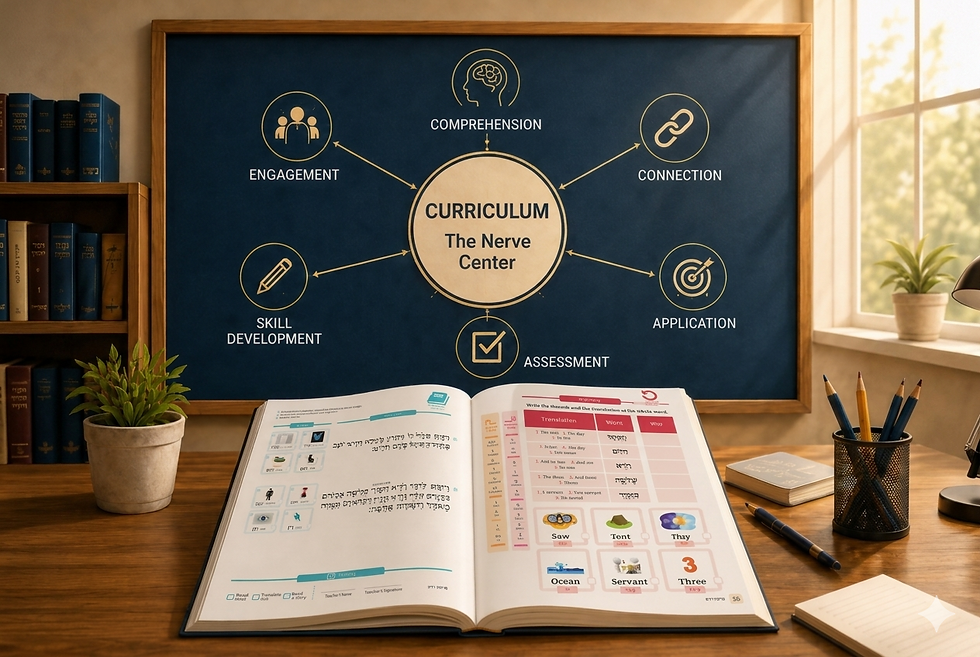
If the goal is independent mastery, the structure of learning must change. Skills cannot remain external supports. They must become internal tools.
This requires a different kind of system—one in which:
Skills are applied directly within the text
Learning is scaffolded toward independence
Each stage is built to reduce reliance on teacher mediation
Skills are understood as the pathway toward independent learning
But for this shift to occur, students must experience the process itself as purposeful. When a learner understands what they are working toward, each step in the process gains relevance. Vocabulary is no longer a list to memorize, but a tool needed to access meaning. Grammar is no longer an isolated rule set, but a mechanism for constructing understanding. Translation structure becomes the process through which the text becomes clear.
In this model, relevance is not added externally. It is created through a visible connection between the goal and the steps required to reach it. Skills are not introduced in isolation, but encountered as necessary tools within the learning itself.
When students experience learning this way, skill acquisition no longer feels separate from understanding. Each step becomes part of reaching a meaningful outcome, allowing learning to move from guided participation toward genuine independence.
Relevance Beyond the Text: Torah as Hora’ah
While relevance within the learning process is essential, it is not sufficient on its own. For learning to become fully internalized, the objective itself must also be experienced as meaningful.
Torah is not studied as an abstract body of knowledge. It is Hora’ah—guidance for how to live. When students recognize that what they are learning has direct relevance to their daily lives, the entire process changes.
The goal is no longer only to understand the text, but to understand what the text demands and how it applies. When this broader relevance is established, the content carries inherent purpose and the process of learning becomes motivated from within. Each step, both in skill and understanding, is seen as part of reaching something meaningful.
This also reshapes what independence means. Independent learning is not only the ability to read and process a text without assistance. It is the ability to engage with Torah as a source of guidance; to learn, understand, and apply.
For this reason, an effective system must address both dimensions of relevance:
Internal relevance — where each skill is necessary to understand the text
Purpose relevance — where the text itself is understood as meaningful to the student’s life
When both are present, learning is no longer experienced as a series of tasks, but as a coherent process directed toward meaningful outcomes.
Stay tuned for Part 2 where we outline what exactly an Applied Torah Learning System is and what it is not.


Comments